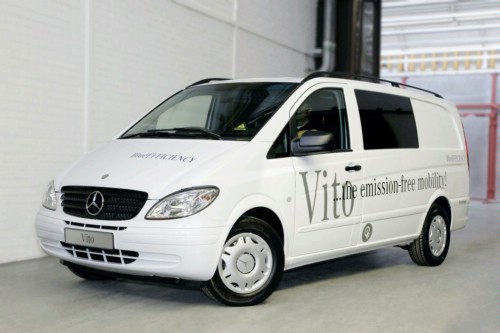
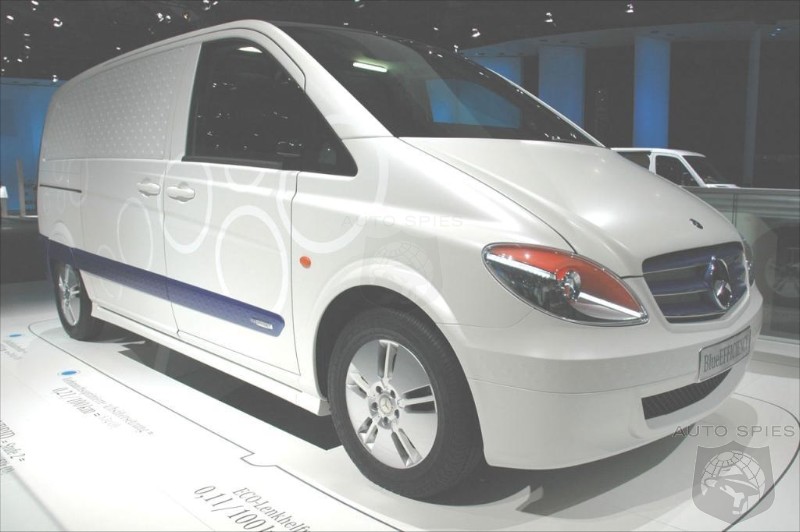
2011 Mercedes-Benz Vito E-Cell

2011 Mercedes-Benz Vito E-Cell

2011 Mercedes-Benz Vito E-Cell

2011 Mercedes-Benz Vito E-Cell

2011 Mercedes-Benz Vito E-Cell

2011 Mercedes-Benz Vito E-Cell

2011 Mercedes-Benz Vito E-Cell

OFFICIAL PRESS RELEASE
- Premiere: first van with ex factory battery-electric drive
- Quiet, emission-free driving in environmentally sensitive areas
- Range 130 km, large load compartment, high payload
- Powerful electric motor with high drive torque
- High-capacity lithium-ion drive batteries
- Intelligent charging technology lowers CO2 emissions and costs
- The usual high quality of service thanks to well-trained personnel
Stuttgart, Germany, Jul 30, 2010 – With the first battery-electric van to be introduced ex factory by any automobile manufacturer, Mercedes-Benz is opening a new chapter in drive technology for light commercial vehicles. Thanks to its emission-free drive system, the Mercedes-Benz Vito E-CELL is ideally suitable for inner-city operations and for particularly environmentally sensitive areas. The Vito E-CELL operates with no emissions and almost silently, and imposes no restrictions on the operator in terms of load capacity and payload. Production of a small series of 100 Vito E-CELL vans has already commenced this year, and a further 2000 units are planned from 2011.
Quiet, emission-free driving in environmentally sensitive areas
Deliveries to inner-city areas and pedestrian precincts, operations in areas with rigorous access restrictions, in-company transport in production shops, delivery access via underground car parks – the quiet, emission-free Mercedes-Benz Vito E-CELL with its purely battery-electric drive system is the perfect answer to the question of delivery operations in environmentally sensitive areas. Moreover, the Vito E-CELL is not only able to carry out its transport assignments in areas with high exhaust pollution, but also where there are noise restrictions protecting e.g. health resorts or in residential areas with night-time driving bans.
In response to the growing environmental burden in the densely populated areas of Europe and other regions of the world, the relevant authorities are increasingly introducing vehicle access restrictions in the form of environmental zones based on emissions or with time constraints. Emission-free vehicles with electric drive are usually exempted. Accordingly the Vito E-CELL is eminently suitable for environmentally sensitive areas, both in commercial and public service operations, and in many areas of the service sector including e.g. parcel and postal deliveries, maintenance work and for other service providers.
There are also numerous incentive schemes for the purchase of emission-free vehicles. These are available in many countries and take widely different forms, ranging from direct purchasing subsidies to significant reductions in toll charges or vehicle taxes and exemption from access restrictions.
The Vito E-CELL is also considerably less expensive to operate. A comparison between the current diesel price and the cost of electrical power shows a factor of four to seven. This means that for the same driving distance, a Vito powered by an internal combustion engine incurs four to seven times the costs of a Vito E-CELL recharged overnight with low-priced off-peak power.
In densely populated areas the future belongs to electric drive
Experts are convinced that in highly populated areas with dense infrastructures, where exhaust and noise pollution levels are high, the future belongs to electrically powered vehicles. Additional incentives include a sense of responsibility on the part of businesses and not least the public relations effect of "clean" drive systems.
Another motivating factor for the development of vehicles with electric drive is the conservation of finite resources such as oil, as well as the political will for greater independence where energy supplies are concerned.
As a pioneer in automobile development and production, Mercedes-Benz has the stated aim of safeguarding and shaping the mobility of the future on a sustainable basis with innovative technologies. The focus is on ecologically justifiable drive technologies such as those collectively termed BlueEFFICIENCY at Mercedes-Benz. The clear objective is emission-free driving, and Mercedes-Benz Vans has come another step closer to this goal with the Vito E-CELL.
All good things come in threes: vans with diesel, gas and battery- electric drive
The Vito E-CELL rounds off the wide range of environmentally compatible vans bearing the Mercedes star to form an ecological trio catering for practically all conceivable operations from specialised short-range to extreme long-distance transport. The lineup has continuously further developed and now almost perfected internal combustion engine systems, natural gas and LPG drive systems, and now purely electric drive.
Mercedes-Benz benefits from a wealth of experience
The Vito E-CELL is based on the wealth of experience in the field of electric drive systems that Mercedes-Benz has accumulated over the decades. As early as 1972 Mercedes-Benz developed its first electric van, the LE 306, which was soon followed by a first large-scale trial with the Mercedes-Benz 307 E. Further experimental vehicles followed with the Mercedes-Benz 308 E and the electrically powered Sprinter, and these are still in customer operations under real conditions today, for example on the North Sea island of Heligoland.
The next step to series production was however always foiled by inadequate battery technology. Apart from insufficient long-term durability, this limited both the payload and operating range to the extent that professional operation in larger numbers was not a viable proposition.
The way is now being cleared by modern lithium-ion batteries with a high energy density, supported by intelligent charging strategies and innovative driving strategies that were not possible in the past. The company is driving the development of new battery systems ahead at full speed, by conducting research and cooperating with partners. The Vito E-CELL will benefit from this when the impending series production commences.
Vito E-CELL: no restrictions in load capacity and payload
With its operating range of around 130 km, the Vito E-CELL meets average customer requirements for a daily van mileage of approx. 50-80 km with a considerable safety margin. At the same time the van's load compartment is usable with no restrictions whatever. With a payload of around 900 kg depending on equipment specifications, the Vito E-CELL is in every respect a fully-fledged van. Thanks to a top speed of 80 km/h it is also suitable for the short inter-urban stretches that frequently occur in densely populated areas and suburbs.
Externally it is only the decor of the Vito E-CELL that distinguishes it from the familiar appearance of the conventionally powered Vito, as the body is completely unmodified. Even the charging socket has found its place behind the flap usually concealing the fuel filler pipe in the lower section of the B-pillar on the left side of the vehicle. The ground clearance and angle of approach/departure are also practically unchanged compared to the Vito with an internal combustion engine. The Vito E-CELL is therefore equally suitable for facilities with steep ramps and approaches.
Powerful electric motor with high drive torque
In place of the usual four and six-cylinder engines plus peripheral units of the Vito, the engine cover of the Vito E-CELL conceals the electric motor and its ancillary systems. The electric motor, a permanent synchronous unit, develops a continuous output of 60 kW and a peak output of 70 kW. Maximum torque is 280 Nm.
As the full torque is inherently available right from the start in electric motors, the Vito E-CELL delivers dynamic performance at the familiar, high level of modern diesel engines. In view of the typical operating profile for the Vito E-CELL, and in the interests of maximising the operating range of the batteries, the van's top speed is limited to 80 km/h.
Power is transferred to the front wheels via a single-speed transmission. This efficient unit was likewise developed specifically for the Vito E-CELL.
Vito E-CELL: the only Vito with front-wheel drive
To save installation space for the batteries, and in contrast to the other models in the Vito series, the vehicle has front-wheel drive. With the exception of a few suspension components adopted from the Vito 4x4, the front-wheel drive system was specially developed for the Vito E-CELL.
In addition to the electric motor, other components such as the power electronics, transformer and the mains charging unit are accommodated beneath the engine cover. The 12 V onboard network was also completely newly developed.
High-capacity lithium-ion drive batteries
The batteries are housed under the load compartment floor, where the propshaft and fuel tank are usually located in the Vito. The batteries are modern lithium-ion units with a high performance and load capacity, a high energy density and a nominal voltage of 360 volts. The total capacity of the batteries is 36 kWh, of which 32 kWh are available to power the vehicle. This proportion of around 90 percent is an outstandingly high figure compared to other electrically powered vehicles.
The battery pack of the Vito E-CELL consists of 16 modules with a total of 192 cells. Each of these cells is monitored by a battery management system. To avoid unnecessary power losses and the risk of damage caused by unauthorised persons when the vehicle is parked, a safety system ("Watchdog") deactivates the high-voltage network when not in use.
Water-cooled electrical components
The batteries, electric motor, converter and other electrical components of the drive system are water-cooled. Unlike an internal combustion engine, an electric motor does not reach its greatest efficiency at around 100 degrees Celsius, but at approx. 30 degrees Celsius. To ensure pleasant conditions for the driver during the colder months of the year despite these comparatively low temperatures, the Vito E-CELL is equipped with a heater booster. This is connected to the high-voltage network and the standard heating circuit in the instrument panel.
Full battery at the charging station after six hours at most
The batteries are charged at charging stations provided to the pilot customers by the two energy providers EnBW and Vattenfall. These companies are participating in the customer trials as cooperation partners in the Berlin (Vattenfall) and Stuttgart (EnBW) regions. The charging stations are installed on the business premises of the fleets involved. The charging socket of the Vito E-CELL is connected to the station using a standard seven-pin charging cable.
The batteries of the Vito E-CELL are charged at 380/400 volt mains. The onboard chargers have an output of 6.1 kW. The charging time depends on the charge status of the batteries, and takes a maximum of six hours if the batteries are fully discharged.
Using an additional charging cable with a conventional domestic power plug, the Vito E-CELL can also be charged from the 230 volt mains if required. This may become necessary if the van is not at the charging station provided when left overnight. In this case the charging time is doubled, however.
Intelligent charging technologies lower CO2 emissions and costs
The design of the Vito E-CELL incorporates intelligent charging technology to reduce both CO2 emissions and costs. The necessary charging intervals are defined with the customer depending on the van's operating profile.
The Vito E-CELL features a Smart Charge Communication Unit (SCCU) as standard, making intelligently controlled charging possible. This ensures that within the defined period, the van is charged precisely when the energy providers supply "green" electrical power at off-peak, overnight rates. The result is a further, drastic reduction in CO2 emissions within the overall energy balance of the Vito E-CELL ("Well to Wheel"), quite apart from the vehicle's zero-emission performance during actual operation.
Moreover, at the multifunction steering wheel and in the instrument cluster, the charging units can be individually set to charge at times when not only ecologically generated, but also low-cost electrical power is available. This can also be done centrally on a PC by the scheduler. The SCCU also allows parallel charging of several vehicles in a fleet, without overloading the mains network.
Apart from this, the ability to charge the batteries at the company's own charging station or power sockets opens up intriguing perspectives: no more time-consuming trips to the filling-station, and if tours are cleverly planned neither the drivers nor fleet management need to worry about energy supplies for the vehicles.
Schedulers can control Vito E-CELL assignments according to charge status
Vehicle availability can also be calculated depending on the charge status of the batteries. A scheduler is able to call up the charge status and therefore the available operating range of the Vito E-CELL on his computer screen, and precisely determine whether a particular van is able to carry out an additional assignment at short notice.
All these intelligent control possibilities protect the environment while optimising customer benefits individually in widely differing businesses and operating conditions. At the same time these complex controls reduce loads on the batteries as far as possible, prolonging their operating life.
Recuperation: braking energy converted into electrical power
In the interests of maximising the operating range of the Vito E-CELL, its batteries are also charged by energy recuperation while on the move, i.e. by converting braking energy into electrical power. Recuperation not only takes place when operating the brakes, but also on the overrun and when reducing speed. All this is in interaction with the new ESP® system.
Based on the long-wheelbase Vito
The Vito E-CELL is based on the long-wheelbase Mercedes-Benz Vito with a standard roof. The long wheelbase of 3200 mm provides the necessary underbody space for the traction batteries. With a permissible gross vehicle weight of 3050 kg, the approx. 900 kg payload of the Vito E-CELL is surprisingly high.
This large transport capacity is firstly due to the relatively compact and therefore light lithium-ion battery, which has a high energy density compared to conventional accumulators. Secondly, it is not least due to intelligent integration of the electric drive system into the bodyshell. The Vito E-CELL is available with both left and right-hand drive.
Extensive and practically oriented standard equipment
The equipment level of the Vito E-CELL has in no way suffered from the efforts to achieve the highest possible payload. In addition to the heater booster, all 100 Vito E-CELL vans have an extensive range of standard equipment plus a heatable luxury seat for the driver, a multifunction steering wheel, heatable and electrically adjustable exterior mirrors, a two-seater bench for the co-driver, two sliding doors, a tailgate and the "CARGO" equipment package.
A reversing camera with a monitor in the cab's COMAND system and the reverse warning device ensure that when manoeuvring at slow speed, the driver is able to recognise obstacles and also quickly notice pedestrians who have not heard the quiet Vito E-CELL approaching.
Active and passive safety at the highest level
The Vito E-CELL has the same, exemplary level of safety as all Vito models with an internal combustion engine. In the event of a collision the batteries are protected by a crash element. When the airbag control unit is triggered, the high-voltage technology is automatically deactivated. The Vito E-CELL has already impressively demonstrated its high safety standard in several crash tests. And should a Vito E-CELL be involved in an accident, the emergency services have special recovery guidelines available to them.
Active safety is also at the acknowledged, high level found in every Vito with an internal combustion engine. Like all other Vito models, the Vito E-CELL features a fully-fledged Electronic Stability Program (ESP) with all the familiar functions, plus a driver airbag and double co-driver airbag.
Mercedes-Benz has ensured a high level of operating safety with extensive trials. To this end, more than a dozen Vito E-CELL vans have undergone extended test drives both on enclosed test tracks and on the roads. Whether in the icy conditions of Scandinavia or the heat of Spain – the Vito E-CELL has already demonstrated its high everyday practicality during the trial phase.
The Vito E-CELL is produced on the same line as the conventional Vito
In contrast to other electrically powered vans, Mercedes-Benz is the first manufacturer to produce the Vito E-CELL on the same lines, together with all the other Vito models, in its Vitoria plant. This further demonstrates that the Vito E-CELL is by no means an experimental vehicle or a prototype, but rather a van on its way to series production.
In view of the completely different drive configuration including a front-wheel drive module, the battery pack under the load compartment floor and the omission of many components, numerous changes and special training for all the personnel involved were necessary in production.
100 Vito E-CELL vans with fleet operators in two cities
Mercedes-Benz will deliver 100 Vito E-CELL vans to customers between August and December this year. Half each will be taken into operation in Berlin and Stuttgart, and further units will be used in the Basque region of Spain early next year, i.e. on the homeground of the Vito E-CELL. The main areas of operation are therefore concentrated on densely populated areas. These not only differ in size but also in topographical terms, ensuring different operating conditions and therefore additional findings.
The customers concerned are predominantly fleet operators. Both the fleet managers and drivers are being intensively trained in the control and operation of the Vito E-CELL, and carefully familiarised with its special features. This also extends to separate operating instructions for the Vito E-CELL.
The usual high quality of service thanks to well-trained personnel
Both in Berlin and Stuttgart, two workshop partners will be responsible for servicing the Vito E-CELL. Their personnel are undergoing thorough theoretical and practical training as a multi-stage process. Service specialists will also be on hand during the start-up phase in case unforeseen problems occur. The European emergency call center operated by Mercedes-Benz in Maastricht is also able to answer queries.
Mercedes-Benz is ensuring the customary, high quality of service processing for the Vito E-CELL. The van absolves the standardised workshop processes, and is e.g. diagnosed using the existing diagnostic systems. This further demonstrates the practically-oriented configuration of the Vito E-CELL with a view to series production.
Innovative business model: monthly user charge rather than purchase price
The customer trials for the Vito E-CELL are scheduled for four years and roughly 80,000 km per vehicle, after which the 100 vans will be returned to Mercedes-Benz. For this reason the customers are not purchasing their vehicles, but rather renting and financing them by paying a monthly user charge which also includes all the servicing for the Vito E-CELL. Ideally the 100 Vito E-CELL vans will cover a total of around eight million kilometres in roughly one dozen fleets during the customer trials – which will provide an unrivalled wealth of experience for the further development of electric drive systems in light commercial vehicles.
Financial support from the federal government
The Vito E-CELL project is being supported from the public purse in various ways. Within the support period, Vito E-CELL customers are able to use the van at no charge for several months. The financial resources are being provided by the German federal government as part of its Economic Support Package II, in which the Federal Ministry of the Environment and Nature Conservation is supporting the development and industrialisation of the Vito E-CELL. This applies to the production and testing of experimental vehicles, as well as the 50 vans for the customer trials in Berlin.
While large fleet operators are the main concern in Berlin, the focus of the customer trials to be held in parallel in Stuttgart is on both tradesmen and fleets. In this case the Federal Ministry of Transport, Construction and Urban Development is supporting customer operations in the Stuttgart pilot region for electro-mobility. In Spain the Basque government is assisting with the construction of the special production facilities for the Vito E-CELL.
In parallel with the practical trials, Mercedes-Benz will evaluate data such as route profiles, operating ranges and other parameters in order to tailor electrically powered vehicles even more precisely to customer requirements.
Next step: series production of the Vito E-CELL starting soon
Mercedes-Benz will have built the small series of 100 vans at the Vitoria plant by the late autumn of this year. The next steps are already scheduled: a further 2000 units are already planned from 2011.
source :http://mercedes-benz-blog.blogspot.com/2010/07/new-mercedes-benz-vito-e-cell-through.html
 2011 Brabus Mercedes-Benz SLS AMG Widestar
 2011 Brabus Mercedes-Benz SLS AMG Widestar
 2011 Brabus Mercedes-Benz SLS AMG Widestar
 2011 Brabus Mercedes-Benz SLS AMG Widestar
 2011 Brabus Mercedes-Benz SLS AMG Widestar
 2011 Brabus Mercedes-Benz SLS AMG Widestar Interior
 2011 Brabus Mercedes-Benz SLS AMG Widestar Seats Interior